

Explore more articles and podcast episodes related to this topic.
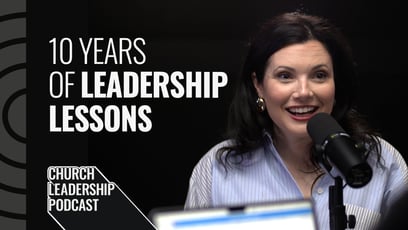
Adam and John are joined by Caitlin Van Wagoner (Watermark Executive Director of Communications) to discuss what we are learning about communication. Together, they share practical tips for church communication in a wide variety of contexts.
Episode Summary
Caitlin Van Wagoner (Watermark Executive Director of Communications) joins Adam and John to discuss what Watermark is learning about communications. Together, they share practical advice for communication in any church context, regardless of size. While not every church has a communications team, every church communicates. Learning to communicate clearly and effectively is the job of every church leader.
5 Things We Are Learning About Communications
- We Used to Think a Stage Announcement Was All We Needed... (02:40)
- We Used to Think Our Content Was One-and-Done... (06:04)
- We Used to Allow Ministries to Run Their Own Offense... (11:00)
- We Used to Think a Good Campaign Was All that Mattered... (17:37)
- We Used to Think that Creativity Mattered More than Function... (21:06)
We Used to Think a Stage Announcement Was All We Needed (02:40)
In other words, what used to work for your church several years ago may not work very well today. Church leaders need to build the habit of constantly re-evaluating their communication methods. Note that there is no one method of communication that is clearly winning today. Successful communication will consider several different methods at once. The communication methods that work for Watermark may not work in your church context.
Don't forget to ask your people how they want to be communicated to. At Watermark, survey results show people primarily gain information from a weekly email newsletter. However, at your church social media may play more of a role. Knowing what communication channels your people use helps you to focus your efforts and improve where you may be lacking.
We Used to Think Our Content Was One-and-Done (06:04)
If you are a church, you are probably a natural content engine. Every given week, you are producing content in the form of sermons, bible studies, podcasts, etc. This content does not have to simply be filed and forgotten about. There are always going to be ways to repackage that content for use in other places. Are you struggling to create something to put on social media? Use clips or quotes from this past Sunday's sermon. Turn a message into a blog post or article. This naturally extends the life of your content without having to create anew. This will inevitably mean less work for those involved in communication. Even if you are not ready to repackage these things, finding somewhere to collect and store these things is invaluable.
We Used to Allow Ministries to Run Their Own Offense (11:00)
"Consistency communicates excellence." - Caitlin Van Wagoner
Now, we seek to lead with them. When a large number of ministries are all handling communication on their own, excellence will often slip. Centralizing communication helps maintain a high level of consistency across the board. Your church's website is the biggest front door of your church and will often be someone's first impression of you. People will always check churches out online prior to visiting them in person. So if you have limited resources for communication, you should focus on improving your website.
If you are looking for ways to increase consistency of communication while still letting your ministries do the work, there are some helpful steps you can take. Begin by making branded Word Doc and PowerPoint templates. These are tools you can arm ministries with them with parameters for their communication. Cast vision for what consistency looks like and why it matters.
We Used to Think a Good Campaign Was All that Mattered (17:27)
"Communication is a leadership tool, but it is never a substitute for good leadership." - Adam Tarnow
You don't want to take too much leadership away from the people you are empowering to do ministry. The success of your communication often lies in the energy and excitement of your people. Communication is a leadership tool, but it is never a substitute for good leadership. Even in a world of mass communication, individual conversations still remain incredibly important. The Communications Team at Watermark helps teams by owning projects along side them rather than simply taking all the work away from them. Set expectations with every project and communications initiative.
We Used to Think that Creativity Mattered More than Function (21:06)
Clarity blesses people and sometimes the church struggles to be clear. Don't let creativity get in the way of being clear. This often becomes an issue with ministry names. When ministries are named something too vague, it creates a barrier for engagement. When ministries are named something too literal, it will lack enthusiasm. However, when in doubt, be clear. Be really thoughtful with names early on.
Conclusion (25:03)
It is important to remember that in 21st century America, your church is not only being evaluated against other churches. Your communication is being evaluated against brands, companies, other media creators, etc. There are hundreds of companies, industries, activities all vying for people's time. This doesn't mean you have to compete with companies like Nike, but it might mean there is something we can learn from them.
Take time to learn what your leadership wants. Then spend thoughtful time understanding how communication helps leadership achieve what they want. When you earn trust, you get leeway.
Lastly, when writing things, make it simpler. Practice the 50% rule. Write to get to the right idea, and then reduce the amount of words by 50%. This will help people actually engage with and read the content. It is a way to serve your reader's effectively.